.png)
Shadow AI: A Guide for Leaders
- Miriam Simon
- Dec 9, 2025
- 2 min read

Last week I was at a talk about AI for strategic advantage. One term kept coming up over and over again.
And I could see from the room that most people didn’t actually know what it meant, but were too polite to ask.
That term was Shadow AI.
If you’re leading a business right now, you need to understand what this is.
Not from a technical angle, but from a strategic one.
Because Shadow AI is already happening inside your organisation.
What is Shadow AI?
Shadow AI is when your team uses AI tools without any approval or oversight.
Important to say that this is not because they’re hiding something. They’re simply trying to work faster, clearer, or with less friction.

Or when they’re simply trying to impress you.
You’ll see it when someone:
• Uses ChatGPT to draft emails or reports
• Uploads data into a free AI tool
• Experiments with AI apps to solve a problem
• Stores business content in a personal account
None of this is malicious. And for some of you, you may not be able to see Shadow AI at all.
However, without clear leadership, it can create bigger issues.

Why this matters for CEOs and Leaders
Shadow AI creates four real risks:
1. Data exposure
Customer, financial or operational information can end up in external tools.
2. Inconsistent reporting
If people are using different systems, you get different versions of the truth.
3. Compliance gaps
Many sectors now require oversight of how data is used.
4. Loss of visibility
It’s hard to lead well when you don’t know which tools are shaping decisions.
But here’s the positive side. Shadow AI also tells you something important:
Your team wants better tools. They want to work smarter. They want less friction.
There’s a huge opportunity in that.
Here are some quick tips on managing this:
And it’s not about locking everything down… It’s about clarity and consistency.
Step 1: Ask what’s already being used
Create a simple, honest conversation:
“What AI tools are you using right now to make your work easier?”
No judgement.
This is about understanding the real workflow inside your business.
Step 2: Set clear, simple guardrails
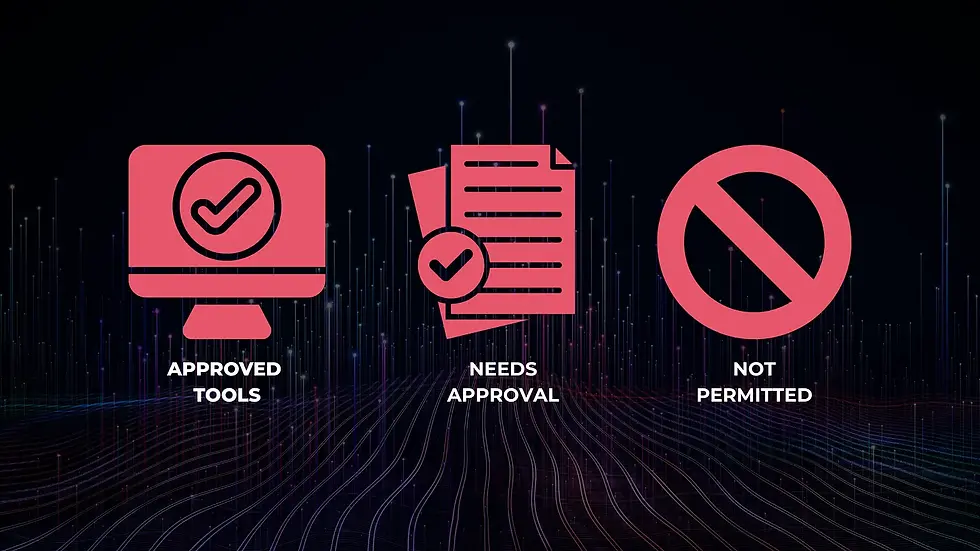
Define three categories:
• Tools we approve
• Tools that need sign-off
• Tools we shouldn’t use
Keep this short and easy to follow.
Step 3: Provide safe, approved tools
Choose one or two AI tools that meet your security and data standards and give people a better way to work.
When good tools exist, Shadow AI reduces naturally.
Step 4: Build AI into your leadership rhythm
Review usage regularly.
Update guardrails as the tech evolves.
Not complicated. Just consistent leadership.
The bigger message for leaders
Shadow AI isn’t the enemy. Unclear leadership is.
When you give people structure, safety and confidence, they adopt AI in a way that strengthens the business rather than exposing it.
This is how you future-proof your organisation, improve efficiency and keep pace with what’s coming next.
Shadow AI isn’t happening somewhere else. It’s happening in your business. The real question is: Where?
Have a great day!
Warm regards,
Miriam.
ps. Please feel free to share this with anyone you feel could benefit.


Comments